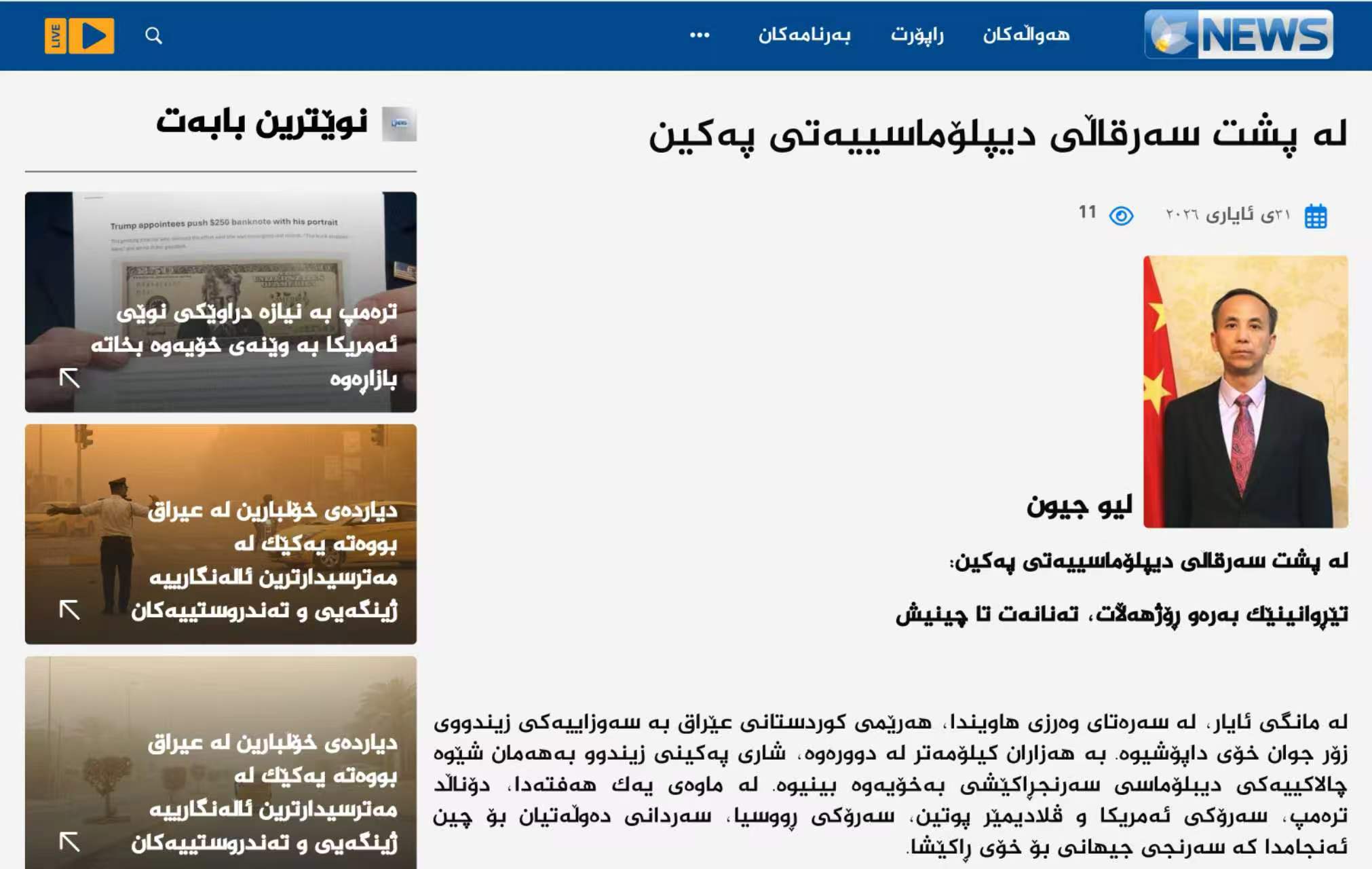
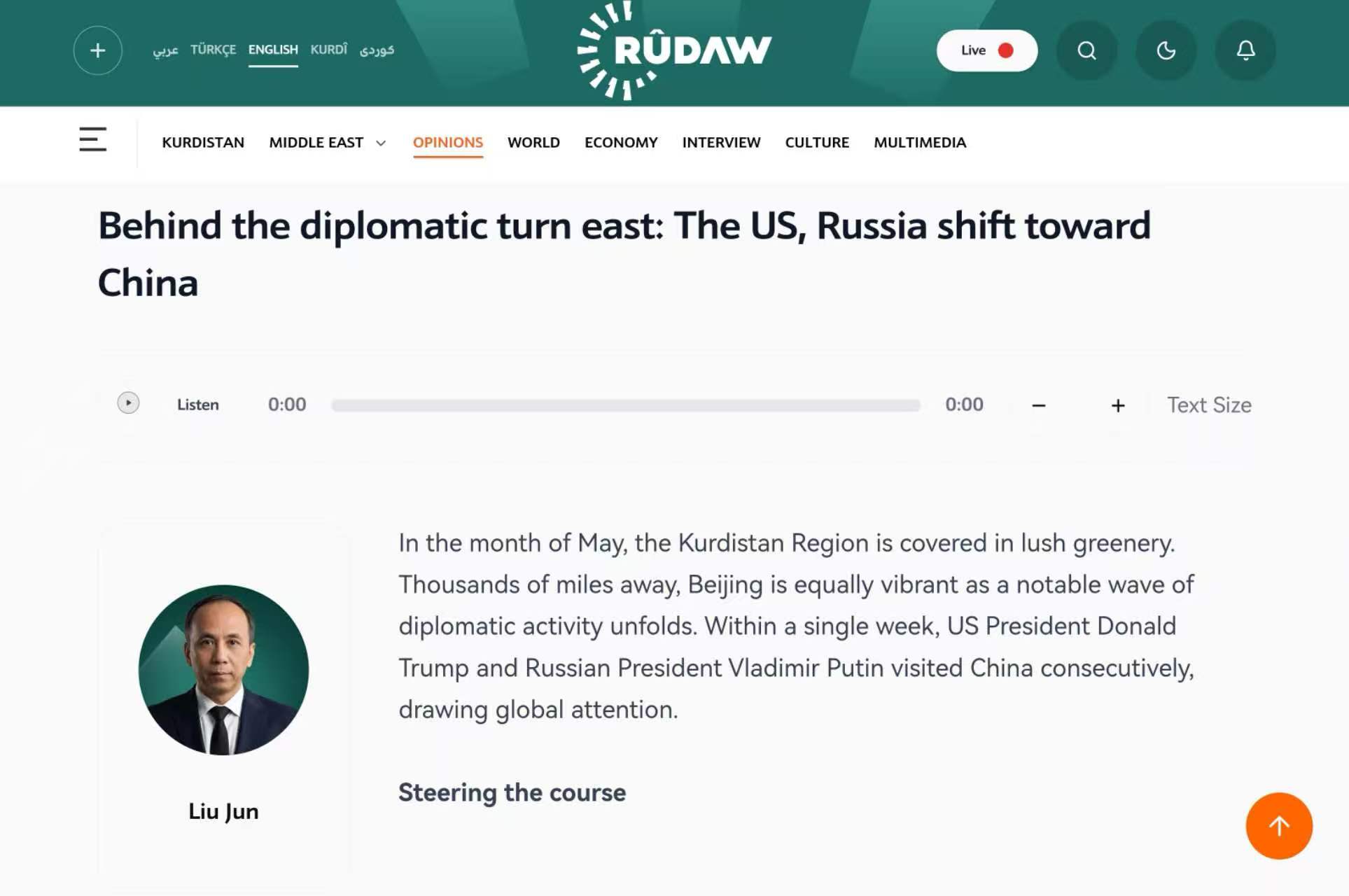
In the May of early summer, the Kurdistan Region of Iraq is clad in thriving green. Thousands of miles away, Beijing is also vibrant as a remarkable wave of “diplomatic fever” is unfolding. Within just one week, US President Donald Trump and Russian President Vladimir Putin paid state visits to China one after another, capturing the world's attention.
I. The China-US Summit: Steering the Course, and Outlining a New Vision
From May 13 to 15, US President Donald Trump paid a state visit to China. It was a handshake across the Pacific and a historic meeting of global significance.
First, it built a new vision for China-U.S. relations. The most important political understanding is that the two presidents agreed on a new vision of building “a constructive China-U.S. relationship of strategic stability”.
—It should be positive stability where cooperation is the mainstay. China and the United States share deep ties. While a confrontational relationship will be disastrous for both countries and the world, China-U.S. cooperation will get many great things done to the benefit of both and all.
It should be healthy stability where competition is kept within proper limits. Competition between China and the US should not be turned into a zero-sum game. It must be a healthy, positive and fair one where we learn from each other, pursue excellence together, compere in compliance with rules and help each other become succeed.
It should be constant stability where differences are manageable. Both sides should maintain policy continuity and stability. A positive outlook of China-U.S. cooperation will provide more certainty for both countries’ development and for the international situation.
It should be lasting stability where peace is expectable. The bottom line is that both sides must abide by the three China-U.S joint communiqués, respect each other’s social systems and development paths, respect each other’s core interests and major concerns, and respect each other’s right to development.
Second, it reinforced consensus on deepening cooperation. The two sides agreed to pursue more exchanges on foreign policy, military-to-military relations, economy and trade, public health, agriculture, tourism, people-to-people ties, and law enforcement. The two sides also agreed to establish a board of trade and a board of investment, addressing each other’s concerns regarding market access for agricultural products, and expanding two-way trade within the framework of reciprocal tariff reduction. Many of most distinguished business leaders of the US accompanied President Trump to China on this trip, and were invited to the official talks. President Xi encouraged them to strengthen cooperation with China, and stressed that China will open its door still wider. They all said that they have a deep commitment to the Chinese market, and want to strengthen cooperation with Chinese partners.
Third, the two sides conducted in-depth exchanges on key issues. On the Taiwan question, President Xi stressed that the Taiwan question is the most important issue in China-U.S. relations. “Taiwan independence” and cross-Strait peace are as irreconcilable as fire and water. Safeguarding peace and stability across the Taiwan Strait is the biggest common denominator between China and the U.S. And the U.S. side understands China’s position, takes China’s concerns seriously, and does not agree with or accept Taiwan’s moving toward independence. On the Middle East situation, President Xi stressed that the use of force cannot solve problems, and dialogue is the only right choice. China encourages the U.S. and Iran to continue settling their differences and disputes through negotiation, calls for reopening the Strait of Hormuz as soon as possible and achieving a permanent and comprehensive ceasefire.
II. The China-Russia Summit: Renewing the Friendship, Together for a Shared Future
From May 19 to 20, Russian President Vladimir Putin paid a state visit to China. It is President Putin's 25th visit to China, coinciding with the 30th anniversary of the establishment of the China-Russia strategic partnership of coordination, and the 25th anniversary of the signing of the China-Russia Treaty of Good-Neighborliness and Friendly Cooperation.
President Xi summarized the future direction of China-Russia relations as “four dimensions of higher quality”.
First is building higher quality political mutual trust and giving each other firm strategic support. The China Russia relationship now stands at the highest level in history as a comprehensive strategic partnership of coordination for the new era, setting a prime example of a new type of major country relationship.
Second is empowering higher-quality mutually beneficial cooperation and jointly advancing development and revitalization for each other. The two sides will deepen the synergy of development strategies, and work to upgrade mutually beneficial cooperation across the board.
Third is promoting higher quality people to people connectivity and strengthening the foundation of lasting friendship between the two nations. The two president have decided to hold the tenth national theme year, namely the China-Russia Years of Education, this year and next. And both sides will take this as an opportunity to further strengthen people-to-people ties and enhance cultural and educational exchanges.
Fourth is pursuing higher-quality international coordination to reform and improve global governance. China and Russia will steadfastly safeguard the authority of the U.N. and international fairness and justice, oppose all unilateral acts of bullying and attempts to reverse the course of history, and especially oppose all provocative acts that deny the outcomes of the victory of World War II and attempt to justify and revive fascism and militarism, and work together to shape a more just and equitable global governance system.
III. The two successive summits between heads of state of major countries were full of highlights and reached a climax. Since the beginning of this year, more than 20 foreign leaders and heads of state have visited China. Under the stewardship of presidential engagement, more and more countries have taken the initiative to get closer to China and seek a better understanding of China, during which they have increasingly placed trust and high hopes on China. As China continues to inject stability and certainty into a turbulent world, “looking eastward” has become the convergent choice of the international community.
For the Kurdistan Region of Iraq, “looking eastward” means looking for security and development. President Xi Jinping called on both the US and Russian Presidents to engage in peace talks regarding the Middle East situation, which demonstrated China's responsibility as a major power, and contributed to maintaining peace and tranquility of the KRI. In response to KRI’s demand for economic revitalization and development, China is a reliable partner for sharing development opportunities and pursuing mutually beneficial cooperation. Whether it is the steady, sustained and long-term growth of China-US relations, or the renewing friendship between China and Russia, both will provide new momentum for global economic development, and will undoubtedly create more new opportunities for the development of the KRI and cooperation between China and the KRI.
As the ancient Chinese proverb says, “True virtue never lacks company.” Looking ahead, China will continue to expand high-standard opening up to the world. We welcome friends from all walks of life in the KRI to join the tide of “looking eastward”, to share development opportunities and achieve mutual benefit and win-win outcomes, to steadily deepen friendly cooperation in areas such as infrastructure, economic and trade, investment, artificial intelligence, new energy, and cultural and people-to-people exchanges, and to usher in a bright future of shared prosperity and mutual success!